- 작성일 2026.04.01
- 작성자 고려대학교 세종캠퍼스
- 조회수 1

A joint research team led by Professor Ahn Junsung of the Department of Control and Instrumentation Engineering at Korea University Sejong Campus and Senior Researcher Kim Hyejin of the Electronics and Telecommunications Research Institute (ETRI) has developed an innovative ‘in-situ’ fabrication technique. This breakthrough allows to produce large-area multimodal sensing platforms without the need for traditional cleanroom processes.
This technique overcomes the limitations of conventional flexible sensor fabrication and presents strong potential for immediate application in various interactive systems, including intelligent robotic tactile systems, human-machine interfaces (HMI), and wearable devices.
Traditional flexible sensor manufacturing typically requires complex mask-based processes and expensive cleanroom facilities, posing significant challenges for large-scale production and cost reduction in real-world applications. To address these limitations, the joint research team utilized only laboratory-accessible UV laser equipment and 3D printers.
As a result, they successfully established a maskless ‘in-situ’ fabrication process that allows devices to be produced directly on-site without additional masking steps. This approach significantly reduces manufacturing costs while enabling flexible design of sensor form factors tailored to complex target materials. Beyond device-level development, the team implemented the technology at the system level and demonstrated its practical applicability in real robotic and human-machine interface (HMI) environments.
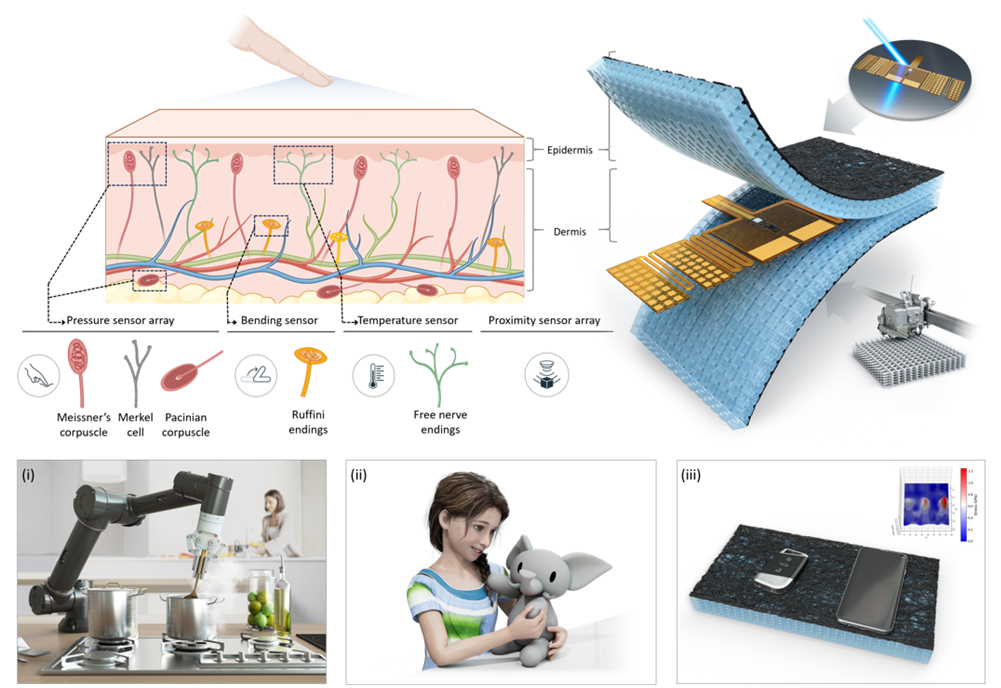
By advancing the sensor technology from device-level innovation to full system-level integration, the study provides a technical foundation for immediate application in robotics and HMI systems. Its rapid prototyping capability, allowing fast fabrication in desired shapes, is expected to present a new process standard for researchers in related fields. The technology is anticipated to lower entry barriers to the large-area flexible sensor market and generate substantial impact across intelligent robotic tactile systems and next-generation interactive systems.
The research findings were published in npj Flexible Electronics (Impact Factor 15.5, top 1.5% in JCR), a globally renowned journal in the field of flexible electronic devices. The paper is titled “Scalable In-situ Fabrication of Multimodal Electronic Skin for Intelligent Robotics and Interactive Systems.”
Master’s student Lim Hakhyun (Korea University Sejong Campus), Dr. Choi Joongrak (ETRI), and Master Han Changyu (Korea University Sejong Campus) participated as co-first authors. Professor Ahn Junsung and Principal Researcher Kim Hyejin served as co-corresponding authors.
This research was supported by the Ministry of Trade, Industry and Energy and the Korea Evaluation Institute of Industrial Technology (KEIT) under the K-Sensor Technology Development Program (RS-2022-00154781), as well as ETRI’s basic research program (26ZB1100) and Korea University.